Featured Post

John Chris' Red Brick Store

The Medina Store as we today remember it, this photo circa 1950's.  Built circa 1883 by John Christophers, former tanner and partner o...

Thursday, April 4, 2024

In the Vicinity


.Lime Creek

Civil War Monument
Medina Center


Demings Lake


Tiffin

Tiffin Mill

C. C. Morse, proprietor of Tiffin Mills
Photo from Lenawee Historical Museum

C. C. Morse from 1874 Lenawee Atlas


House built on land first deeded to Nathaniel Upton, perhaps built by him or by J. G. Smith, brother-in-law of neighbor George Washington Moore. In the late 19th century this was the home of the John Monahan family.


Location of the early home of John Foster, across from Tiffin Mills.  The house burned in the early 2010s.

Tiffin house closest to Tiffin Mills location

The middle house at Tiffin Mills

Not right at Tiffin Mills, but on Hughes Hwy. north of the fork in the road to Tiffin.

Upton/Smith/Higley/Monahan farm buildings on Medina Rd.


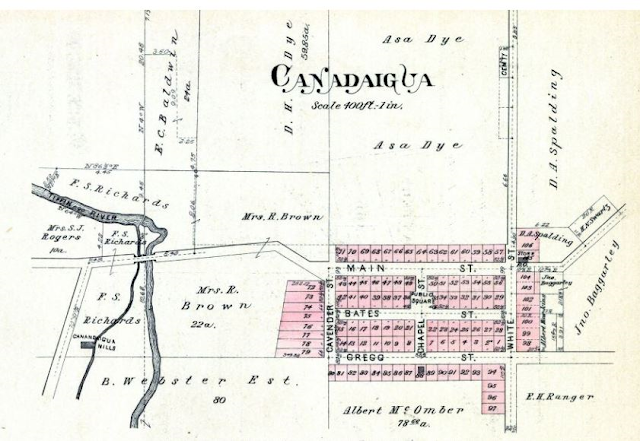
Canandaigua


On Canandaigua Road to the west of Bean Creek and the village.  This is near where the Canandaigua Mills used to be.  There are no known pictures of these mills of the past.

Entering the village from the west, the old William Cavender farm is on the left.

On Gregg Street looking west.

Back of the old store, now demolished.

Church and school building from Gregg Street.
Barn corner of Gregg and Cavender Streets, at the old Webster farm.

Cemetery on the highway.  Those trees were once small shrubs over a hundred years ago.  See "Photographs" Page photo, when M-156 was a narrow dirt road.  This is what happens when you don't keep your hedge trimmed!

Bates Street looking west.

Old store in the 2010's, now demolished.  Annis Darr's parents met here upstairs at a dance in the 1880's.


Large brick home of Sylvester Slater, 1873 Lenawee Plat Book,
Harris Hwy., Sec. 12 Medina Twp.  Mr. Slater was a Landlord with a personal worth of $45,000 on the 1870 census, and living with a younger Mr. Richards, a merchant (his probable son-in-law)  By 1880 Mr. Slater is at the same location with occupation Miller.  

1874 Lenawee Atlas shows Section 12 Medina Twp. shows J. Richards land on what is later named Harris Hwy., and also to the west of the village with the * symbol tht means mill location.  This is 40 years after settlement and the Cavenders have been replaced by the Dye family; Samuel Gregg moved to Adrian and they had the Websters at the corner farm on Gregg Street and the Macombers to the south.


First wife of the Hon. Philo Wilson of Canandaigua.  Philo is buried here next to his first wife and child in an unmarked grave.  Notes from his obituary are available at his Find-a-grave memorial here and from a Lenawee history book a short biography of this important early settler who was once Judge of entire county and twice a state legislator. The convention of 1856 was the last for the Whig party which elected President Millard Fillmore, who had ties to this county--his sister is buried pioneer row Oakwood in Adrian.  We could image that Philo Wilson and President Fillmore were acquainted.


1857 wall map of Lenawee, showing properties of Philo Wilson and others.  Another important early settler was C. H. Baldwin.  A short biography of Mr. Baldwin is available at his Find-a-grave memorial.

This 1864 wall map of Washtenaw and Lenawee Counties shows the village lot numbers, as well as a business directory with references to Dr. Chappell, Mr. Cross the saw miller (later of Clayton, if I'm not mistaken), and Baldwin and Crouch, manufacturers of wagons and horse rakes.  There is also a second church shown at Chapel and Gregg Streets.


1893 Lenawee plat map shows increased land holdings for Mr. Richards of the Canandaigua Mills, as well as newcomers Ranger, Spaulding, Hawkins, Baggerly and Mrs Brown.

Site of Sanuel Gregg's first tavern and the first hotel (lot). And some of the great places left in the village.

Beautiful old houses

Cavender farm


Main Street near Cavender.
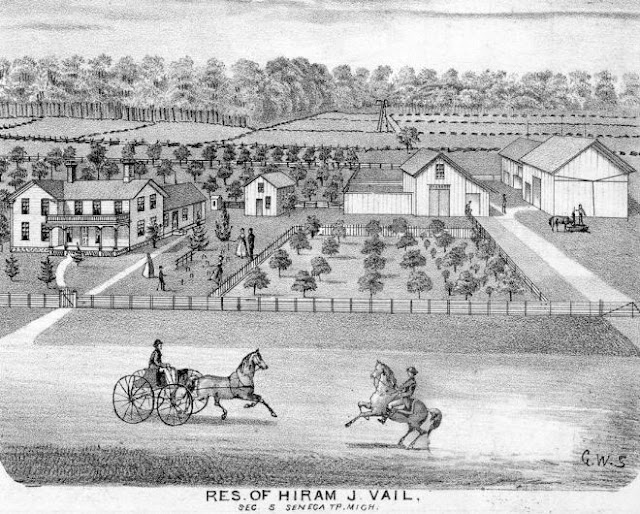
Moses//Hiram Vail farm east on Canandaigua Road from the 1873 Lenawee Atlas.

Old Vail home in 2010's before demolition.  It was located at the junction of Canandaigua and Medina Roads.  A barn or sheds may still be there, and it is shown in Google Maps.  Many pioneer families are related to the Vails; for instance,  Mrs. Isaac Warren of South Dover was a Vail, the mother of Darwin, Isaac and Harriet.

S. K. Kinney place Section 7 Seneca Twp., a mile or so SE of Canandaigua.  According to his biographies I've read, Mr. Kinney was an extremely early pioneer in Lenawee County and his family were extensive farmers in Seneca.  This is from the 1873 Lenawee Atlas.

Samuel Kinney house 2010's Packard Rd., Sec. 7 Seneca Twp.

Short bio from Illustrated History and Biographical Record of Lenawee County page 161.  Samuel's wife Mary was a Secor of a Seneca farming family.  After her father died in 1849 (and was buried in Morenci), some of the family moved to Toledo to make their fortunes and it seems they did do just that. Secor Road, a main thoroughfare of West Toledo is  named after them.  If you check Find-a-grave, it contains some biographies of the Secor family of Toledo.

Photographs


City Fathers Oct. 20, 1898.  This photo was donated to Hudson Museum by the late Lynn Huff, grandson of Oliver Bentley (holding jug).  Annis Darr wrote about all these men in her history except Lyman Cooley, who was apparently in town visiting his brother Orange. The Cooley brothers were great uncles to Annis Darr.


Aldrich J. McLouth in his Old White Store on a bright summer day 1906, the year his daughter Mattie married Abner Griffith.  Note the telephones and the big red coffee grinder recalled by Maude Ingall Carpenter; from Hudson Museum.


Canandaigua Cemetery early 1900's Photo:  David V. Tinder Collection of Michigan Photography, Wm. L.Clements Library, University of Michigan.

Cheese factory interior early 1900's, real photo post card taken by Hudson photographer Perley Lord, who also took the Medina Village mills photo.  We cannot say for certain the location of this enterprise in the photo, but Mr. Lord's studio was in Hudson.   Photo:  David V. Tinder Collection of Michigan Photography, Wm. L.Clements Library, University of Michigan

Ernie Palmer's Blacksmith Shop on south side Main St. between Bothwell and the Church, circa 1903. L to R. Charles Covin (1857-1939), cheesemaker at Colvin's Cheese Factory; Charles Guss (1843-1925), farmer and Civil War veteran; Al Mosher, apparent assistant to Ernie; Ernie Palmer (1867-1937) uncle to Annis Cooley   Photo Hudson Museum

Cornelius Brazee at his shaving horse, preparing wood for his famous splint baskets, circa 1898.  Grandpa Brazee lived at lots 2 and 3 in Section 9, with neighbors Dr. Ely, Dr. Coffin, and the Guss family across the street.  There is a photo of him with his large family at his Find-a-Grave memorial (See useful links in the sidebar).  This scanned photo provided by Cornelius' descendant Mike Disbrow, who informed us that basketry of Cornelius' son is on display at the Manton Historical Museum.


Wednesday, April 3, 2024

School Days


Oak Grove Academy 1874 photographed by F. D. Foster (cropped) courtesy of Hudson Museum.  The Tinder Michigan Photographers' file shows a Frank D. Foster in Hudson during 1874-1875, so that appears to be the date of this great photo.  We may be able to discover the teacher(s) name(s) now that we have a year.  I have seen an earlier photo, probably circa 1860 that I may be able to get posted whenever I am able to get permission from the owner.  The trees are smaller and the girls' dresses are more obviously Civil War-era, bulky skirts and aprons.  The trees were planted in 1853 when the school was built, so the trees in this photo are around 22 years old.  I am guessing the man with beard and arms folded is Professor John Drake as shown with his family in the 1870 US Census.  Some of the students may be of the families Strobeck and  Worcester; the preachers' kids of the two churches; children of Dr. Seeley; and there are many students with different last names shown living with many village families.  There are several female teachers including Eudora Harrington and Addie Heydenberk.  These names are from the 1870 census.  There is no known student list from Oak Grove Academy--the Academy register only records board minutes with references to teacher hiring, building maintenance and other policies.


Medina Village School  circa 1885. Back row:  Will Tew, Carrie Darr, Ellis Guss, Genie Bennett, Minnie Mann, Clara Gambell, Val McLouth.  Second row from back:  ____Avery, Clyde Tew, Roy Farnsworth, Electus McCormick, John Manning, Bert Trumbill TEACHER, Milly Kime,   Annie Gambell, Lizzie Farnsworth, Effie Gambell.  Bottom row:  Sam Darr, Allie McLouth, Jim Avery, Clyde Manning, Jay Cooley, Clark Rorick, Lewis Guss, Maggie Darr, Mattie McLouth, and Florence Colvin.  Photo courtesy of Hudson Museum.


Tiffin (Peg Town) School on Medina Road circa 1894
Girl marked with 'x' looks like Maude Burdick--and about 12 yrs old-- (1882-1908) and probably some of her brothers (ages 14, 8, 6 and 4) are here also, unmarked--Loren (1880-1958), Harry (1886-1960), Ralph L (1888-1957) and Louis A (1890-1964); brother Clarence (1893-1897) is buried at Medina Village cemetery.  Their parents were Geo. Washington Burdick (1846-1921) and Clara E. Lawrence Burdick (1849-1907).  Geo. W. Burdick was a hired hand on the G.W. Moore farm in 1870; later the family lived at the John Foster farm (later owned by Cooleys).  Mrs. Burdick's sister Effie was married to Geo. Daniel, son of G. W. Moore, and lived across the road in the big square house on the Hudson Twp. side of Medina Rd. near the school.  Some of the children of Geo. and Effie are probably in this photo:  Mabel (b. 1878), Wm. A. (b. 1880), Jessie (b. 1886), Ettella (b. 1887), and Guy aka Jack (b. 1891).  Data from FamilySearch.org Family Trees.  Photo courtesy of Hudson Museum.


Medina Village School  May 20, 1904.  This photo donated to Hudson Museum by Lynn Huff, sitting behind the "X" on the desk in front of him.  We may be able to identify some of these students and the teacher, as time goes by.


Medina Village School 1918-19
FRONT 1sr row:  (Robert Guss and Malcom Johns not in school at this time), Euletta Shaffer, Pauline Johns, Alice Guss, Virginia Rhoads, Vivian Shadbolt, Margaret Distler.
SECOND row:  Gaylord Darr, Rex Robinson, Glen Robinson, John Shadbolt, Jr., Lee Hayes, Howard Fike, Norman Darr, Oliver Keller, Ray Fike.
THIRD row:  Vaughn Hayes, Ruth Tew, Helen Guss, Thelma Keller, Murial Stone, TEACHER MIles Root, Helen Milliken, Virginia Hayes, Harriet Tew, Marjery Johns, Elizabeth Stone.
FOURTH row:  Carl Mackey, Glen Guss, Earnest Rhoads, Joe Milliken, Clair Moyer, George Tew, Albert Griffith, Alfred Griffith, Charles Fike, Lester Fike.
Photo courtesy of Lenawee Historical Museum.


Medina Village School 1922-23
FRONT 1st row:  Anna Shadbolt, Alice Hayes, (Ivy?) Thomson, Pauline Shaffer, Maviery Flemming, Angeline Shadbolt, Vivian Shadbolt, Euletta Shaffer, Grace Scott, Ruth Shadbolt.
SECOND row:  Oliver Keller, Eugene Scott, Paul Distler, Kenneth Hayes, Howard Fike, Ray Fike, unknown, unknown, Robert Distler, Robert Guss, Sanger Punches, Gerald Brink. 
THIRD row:  Eudora Griffith, Alice Guss, Margaret Distler, John Shadbolt, Jr., Lee Hayes, Guy Punches, Lloyd Grubaugh, Vaughn Hayes, Glenn Guss, Fred Shadbolt, Donald Guss.
BACK row:  Elizabeth Stone, Carl Mackey, Carl Punches, Loren Tew, Lester Fike, TEACHER Floyd Lerche.  Photo courtesy of  Lenawee Historical Society.


Yellow brick school--Medina Fractional District Number 2, built 1872.
Photo:  David V. Tinder Collection of Michigan Photography, Wm. L.Clements Library, University of Michigan
This school is believed to have been built on an expanded piece of land where the original frame school house was also located, the one that was also used by the Baptist Church at an early time prior to 1846.  The lots were once owned by one of the Daniels brothers and there were a couple of residences along an extended Eagle Street to the west.  This school faced Warner Street.

Detail from above Photo:  David V. Tinder Collection of Michigan Photography, Wm. L.Clements Library, University of Michigan

2022 UPDATE:  In some handwritten stories by Annis Darr sometime in the past year I have seen reference to the original frame school house being located on "the road to Canandiagua"!  


Wednesday, November 23, 2022

1929 Cyclone

View of Main St. from the south.  Photos taken by Stanley Stone, Publisher of the Hudson Post Gazette and Medina native.  Photos from Hudson Museum.  Huff/Colvin house is in center with the ell on back and damaged water tower; directly across the street from Huff house is the Shadbolt house, damaged on it's east side. Photo from Hudson Museum.


“Village of Medina:  Entire Western Half of Lenawee Suffers Damage from High Winds”  Loss Placed at $40,000 with thirteen buildings nearly or partially destroyed.  Luckily there were no serious injuries inflicted. Beautiful trees ruined

Hudson Post Gazette (next issue after Friday, June 28, 1929) by Stanley Stone, Publisher
(From articles on file at  Lenawee Historical Museum, thank you to Kathy Julian)


One of the oldest settled sections of Lenawee county, the village of Medina, settled, according to the records published in Bean Creek Valley, was visited shorly after midnight Thursday night by one of the most destructive wind storms that has ever visited Lenawee county, at least since the early settlers slowly wended their way in.  Medina was settled some 90 years ago and in the terrific storm of Thursday night, or early Friday morning, some of the original houses built in the early days of this old settlement bore the brunt of the twisting cyclonic storm.

The entire loss to the home-owners of Medina village and the farmers just to the east will without doubt total upwards of $40,000.00.  Four of the homes are entirely without wind insurance of any kind.  The balance are pretty well covered.

Friday morning the work of removing the limbs and branches from the highway and street commenced and spectators turned in and helped with the work with a will.  Throughout Friday, Saturday and all of Sunday a constant stream of autos wended its way to the village to view the wrecked homes and see the terrible damage accomplished by the cyclone.
The storm came from the southwest and traveled across the village without damage till it reached or passed the main four corners, when it reached down with fingers of diabolical fury and the first house to receive the full fury of its terrific force was the home of D. C. Nye, ripping the roof and chimney from this home; it threw them across the Manley and Gertie Kime home, just east, smashing in their roof and rear part of the house.

The storm then traveled almost directly eastward along the south side of the village and every house, yard and all the many beautiful shade trees felt the twisting force of the cyclone with the result that thirteen buildings all told were damaged to such an extent that they were rendered uninhabitable.  Every shade tree was either toppled over or stripped of its branches.

When morning dawned the entire eastern end of the village street presented a mass of tangled wreckage with huge limbs and twisted tree trunks covering the broad roadway.

Of these thirteen buildings four were entirely without wind insurance and their loss will be heavy.  Just to show the ready sympathy that responds to every great disaster, to every real financial loss of those least able to bear it.  A subscription paper was immediately started Friday and kept passing among the thousands of visitors from all over this section of the country who commenced to drive in to witness the effects of the storm and the disaster that had come to the owners of the homes.  The collection of money was steadily mounting and without doubt will reach to an amount that will very appreciably help every sufferer from the storm and possibly may entirely place their homes and buildings in just as good shape as they were before the storm.  Although money can never replace the big, beautiful shade trees that are totally ruined and are gone forever.  The entire eastern end of the shady shreet is wrecked in this way for many years to come.

In this connection it is somewhat interesting to note that the famous oak monarch that has stood in front of the Oliver Hotchkiss home (now Wirick home) withstood the storm with the loss of only a big branch.  However, in the same yard was another monarch of the forest, a big hickory, three feet in diameter that ws tipped over and various other trees in the beautiful yard full of trees are also destroyed.

Following the demolition of the roofs of the Nye and Kime homes the Joseph Dilworth house next east was similarly visited and ten trees torn down, the roof torn away and the walls of the house damaged extensively.

The George Huff home next east of Dilworths was about the worst damaged house in the village, the roof being torn off of both the upright and the ell running to the southward.  Mrs Huff was pinned in her home and her husband who works in a Jackson factory being away, it was several minutes before she was extricated from the wrecked home and taken to a place of safety.  

The Hugh Shaneour home suffered severely with the roof town off and the three magnificent maples located in the front yard reduced to twisted tree trunks and shapeless masses of foliage.  These trees each had a spread of some thirty feet and were beautiful trees.  They can never be replaced except by the slowly working hand of nature.  Then across the Canandaigua roadway and next in line on the same side of the street was the Punches home with was not damaged so badly.  

Next in line was the Wirick home (formerly the old Oliver Hotchkiss home) famous for its big yard full of big trees, which we have mentioned before.  The house was not damaged, but at least a half a dozen of the fine trees of different varieties were uprooted and destroyed, including the 100-foot tall hickory, three feet in diameter at the base.

At the diversion of the Canandaigua road from Main street the storm evidently parted and took a northeastern route.  However the damage begon on the north side of the street one block back where the Masonic hall now used by the ladies of the Baptist church suffered damage with shingles ripped off the roof, windows blown out and other damages.

Next east, the John Shadbolt house received damages and as the storm came up Mrs. Shadbolt started up the stairway to look after the children.  Nine children were sleeping there.  She started to close the bedroom windows when a board came hurtling through the window striking her in the back; one daughter, Frances, was struck on the face by flying debris and cut slightly.  The entire roof of the house was carried away and the side walls ripped out.  Repairs to the house seem useless.  A barn in the rear was also leveled to the ground, but the debris so fell that it did not damage a Ford car much.  Mrs. Shadbolt’s husband was in Toledo at the time the storm came; he works in a Toledo factory.

The Ed. W. Smith home next east was badly damaged when two large trees toppled over into the roof.  The porch was crushed in and other damages done.  Next came the Elmira Hemmingway residence and here the division of the storm was marked for the house itself was not damaged, but shade trees on each side of the house were uprooted and denuded of foliage and shrubbery of all kinds was destroyed.  A small auto was turned over on its side.

The farmhouse of Samuel Fike was damaged somewhat, and a barn in the rear, forty by sixty feet was leveled to the ground.  The windows in the house occupied by Geo. Miller were blown out and shingles torn off.
 
Next came the fine farm home of Ralph Tew, who is well known as a chicken farmer, with several thousand of white leghorn pullets and young chickens just now being brought to maturity.  One chicken house 20 X 52 feet was swept clean of its foundations, blown several rods to and on top of a tool house demolishing it.  The northwest corner of the barn was also demolished.  West of the house six shade trees were blown down and destroyed, the yard was full of debris of all sorts and kinds.  A new wire fence on the west side of the farm had so much debris blown up against it that flattened to the ground and will have to be reset.  Mr. Tew counted __00 (cut off) pullets killed or maimed and he estimates his loss at about $1,000.

__ storm lifted after damaging his property and one mile east dipped
__ the farms of his two brothers, Miland and Alton Tew, where the big
__s so twisted with roofs town off and sidewalls and beams town out
__on as to be a total loss.  A toolshed, one hundred feet long was also
____ destroyed.  The next farm visited was John Roberts, two miles
__st, where the damage was comparatively slight.
(Last few lines of this article was cut off on far left side)

And a week later this article from Lenawee Historical Society Museum clipping:


Huff home, previously belonging to the Colvin family and believed to have been built by Dr. Carlos Hampton in the 1850's (present site of the Mero house) This house was a total loss despite the curtains still hanging inside--see cyclone panoramic view above.  Photo from Hudson Museum.
Unknown foundation.  Photo from Hudson Museum.


Looks like Almira Hemenway place, later known as the Bluntschley place. Photo from Hudson Museum. 


Once home of Ben Heydenberk and others, with a large barn in back once used as a cooper's shop (see panoramic cyclone view); at time of the cyclone it was the Edward W. Smith place.  Smith's family continued to live there and the house still exists on Main St. today with an enclosed porch. Photo from Hudson Museum.

Could be at Fike's (on Eagle St.) or Tew's (old Lyon farm on east Main St.) Photo from Hudson Museum.

Dillworth home on left (once the Fessendens and later home of cheese maker Fred Bryan);  Kime home on right (once home of shoemaker Mac McGibbon)  The Kime house was a total loss and the Tew benefit was held primarily for brother and sister Manly and Gertie Kime, whose  late father Chris Kime was a village blacksmith. Photo from Hudson Museum.

This appears to be the Shadbolt house from the looks of the front (see cyclone panoramic view) and from the presence of so many children.  Nine children were sleeping upstairs when roof was carried away (the side away from the camera) and sidewalls were ripped out.  This house was immediately west of the Smith/Heydenberk house with the damaged porch, on the corner of what was once Center St. and Main St.  It can also be seen in the Smith house photo above at far left.  The Shadbolt house was previously home to many including Dwight Buck, Edwin Carter, the Sharr's; it was usually associated with the workmen's shop or wagon or blacksmith shop to the rear.  Chris Kime used to live at the very rear of this section on the south side of Eagle St. Photo from Hudson Museum.


Not sure what house this is where the tree is uprooted. Believed to be in the village. Photo from Hudson Museum.
Believed to be Mary Norine McVay Blaker and friend, somewhere in Medina village.  Norine was in the village the night of the cyclone, and according to her daughter Sandy she stayed that night in a house that sustained damage.  Joyce felt one of these young women was their mother (see her photo at Find-a-Grave posted by Joyce).  I scanned as high as I could but could not get detailed enough.
Back of the photo says Near Hudson and 1928 Chevrolet.  The house looks nearly identical with dark siding (see Vintage Aerial, which I can't post as it's copyrighted) to the Burns place SW corner of Tomer and Bothwell.  I lived nearby and the upward sloping to the house looks right, though it's always possible it could be another place.


Saturday, March 20, 2021

Temperance Hall


This is a photo of the Baptist Ladies Hall in the early 1900's, situated at Section 8 Lot 5 in Medina Village.  In the early 1840's this building was known as Temperance Hall and owned by E. C. Coats, village tailor--full name Elisha Coats. See the location on the 1864 map below.  Keep in mind that the Red Brick Store had not yet been built at Section 8 Lot 8, and there was an earlier, smaller business building there at that time of this map.  Temperance Hall at Sec 8 L 5 is shown in RED while the other lots are shown in BLUE.  See the next photo below with Lot numbers above the buildings.  That is another early 1900's photo, so the buildings are slightly different than in the map.  I used this map as it's the only one with both building symbols AND lot numbers.


The link to the entire 1864 map above is available at the "Maps" tab on this website.


In the property tax records at Lenawee Museum, the earliest recorded owner of Section 8 Lot 5 that I could find is E.C. Coats.  That is in 1844 and there is a notation that it is "Temperance Hall."  

Now for the discussion of this building:  Joyce Longo devotes a page to it in her Historic Calendar, see the tab for it on this website, go to the month of August.  Joyce believed that this building was once the original Baptist Church--but that was before seeing the property records research.  Also, we discussed the possibility because of the bell on top, and also before we knew the existence of any "Temperance Hall," which is is referred to many times in the property records from 1844 onward past 1860.  Joyce admitted to me that this could be incorrect, but she went with the information she had at the time.

Annis Darr called this building the Baptist Ladies Hall (the photo post card is labeled Ladies Hall at the bottom) and it was used for suppers and bazaars for many years.  In Annis Darr's HANDWRITTEN history notebook at Hudson Museum, I later saw reference to the bell being added after the Oak Grove Academy closed--this was the original Academy bell.  That was in the early 1890's.  

Annis' typed history also says Baptist Ladies Hall was once the Masonic Hall; and also that after John Christopher died in 1895, his brick store closed and was sold to the Masons.  So that was around the same time the Academy closed and became a Grange Hall.

I have never seen reference to the location of the original village school and church, that is the church prior to 1846 that was when the present main section was built--until I read the website of Medina Federated Church which claims the school and church shared a building in the beginning.  Now Mr. Ron Hauter donated on behalf of Medina Township the early Township record books, including the school records to Hudson Museum.  I looked all through the District 2 book that was for Medina village and I was unable to see a definitive location.  There was reference to a small dwelling next to the original frame school--and the frame buildings were sold and hauled away AROUND THE TIME OF the building of the brick school in 1872.  I don't recall what happened to the small dwelling, but the school building was hauled across from the "House on the Hill" on Warwick Rd., according to Annis Darr.  There were several dwellings on west Eagle St. north of the school that no longer exist.  

In addition, I believe that I've seen a property tax reference to a "Village Lot" owned at an early time by one of the Daniels brothers on the west side where the school lot was.  It never said for church or school, but I suppose it COULD have been what was meant by Village Lot.

Therefore, I believe the original church and school shared a small frame building on Warner St. near the corner of Eagle St. where only an old garage exists today.  I doubt that Joyce Longo would disagree and I do not wish to diminish in any way her very interesting Historical Medina Calendar.

Mr. Ron Hauter also has recently donated to Hudson Museum a CHAIR decorated with the writing "Sons of T" which I believe to refer to Sons of Temperance, probably a group that met at Temperance Hall.  If anyone has any additional information, please leave a comment.below.

See Hudson Museum public Facebook for a photo of this excellent example of a Sons of Temperance chair.  

In 1856 Medina men formed the Medina Thief Detecting Society with officers John G. Smith (brother-in-law of G. W. Moore who lived on the farm to the west of Moore on Medina Rd.) and Charles Brown (Proprietor of Old White Store after E.D. and John Allen moved to Morenci).  The meetings of the society were held at Temperance Hall as laid out in the introduction to their constitution and bylaws as shown below.


We are indebted to the Lenawee County Historical Society for access to this document from our past.  I failed to scan any more of this document but the rules for the society are laid out in the pamphlet.  It was printed by A. E. Allen, apparently Augustus Allen, son of Erasmus Darwin Allen, the first publisher of the Observer in Morenci (called the New Era in 1872).  For this history see State Line Observer of Morenci under Morenci History Part 2.  We are also indebted to the State Line Observer for access to their excellent historical online archives created by publisher David Green.